The rapid growth of the data center industry has increased demand for modular fabrication methods that accelerate construction schedules while maintaining quality and consistency. As a result, many manufacturers are evaluating data center fabrication crane solutions that can support changing production requirements and larger module sizes.
Rather than constructing critical infrastructure entirely onsite, many organizations now fabricate modular skids in controlled manufacturing environments before shipping them to the final installation location. These prefabricated systems contain mission-critical infrastructure mounted on structural steel frames and commonly house electrical equipment, mechanical cooling systems, and even complete IT whitespace modules.
As skid sizes continue to increase, manufacturers must carefully evaluate how these assemblies will be safely and efficiently handled throughout the fabrication process. Selecting the right data center fabrication crane is an important part of supporting production goals, maintaining flexibility, and preparing for future growth.
Understanding the Challenges of Data Center Module Fabrication
Data center modules are often large, heavy, and complex assemblies. During fabrication, these skids may need to move multiple times between workstations for welding, assembly, electrical integration, testing, and final staging.
Unlike traditional manufacturing environments, production requirements in the data center industry continue to evolve rapidly. Fabricators frequently reconfigure layouts, add new production lines, or expand capacity to keep pace with market demand.
As a result, manufacturers often face several challenges:
- Large module sizes that exceed the capabilities of conventional lifting equipment.
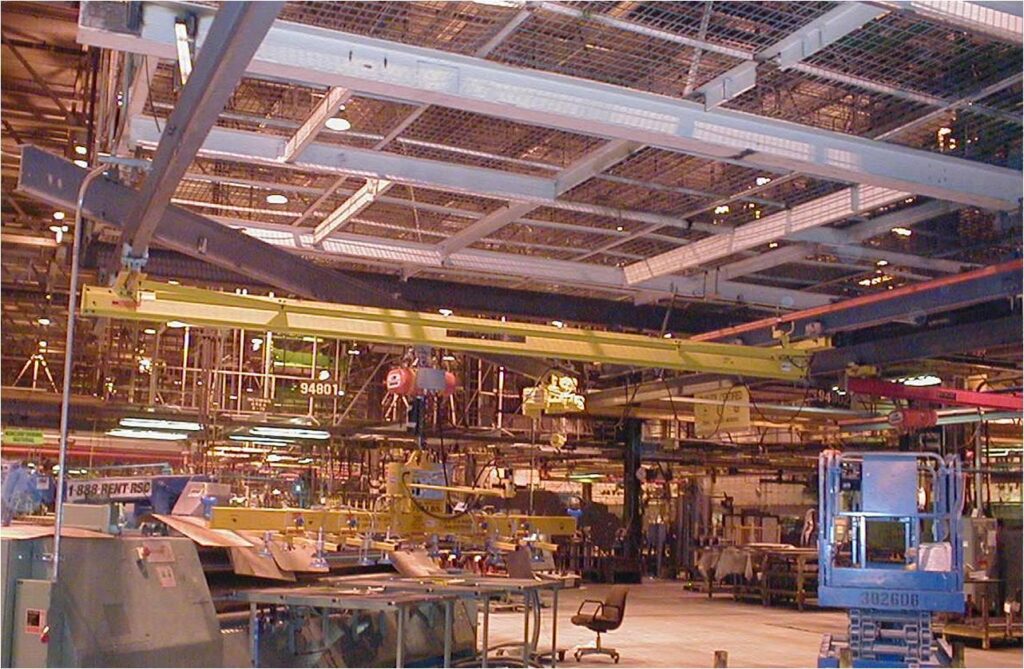
- Limited building structure available to support large overhead bridge crane systems.
- The need to maintain layout flexibility as production requirements change.
- Aggressive project schedules requiring shorter equipment lead times.
- The need to safely handle long modular skids throughout the fabrication process.
These factors make it important to evaluate not only lifting capacity, but also how the material handling system supports the overall manufacturing process.
Why Gantry Cranes Are a Good Data Center Fabrication Crane Solution
 For many manufacturers, gantry cranes provide an effective data center fabrication crane solution.
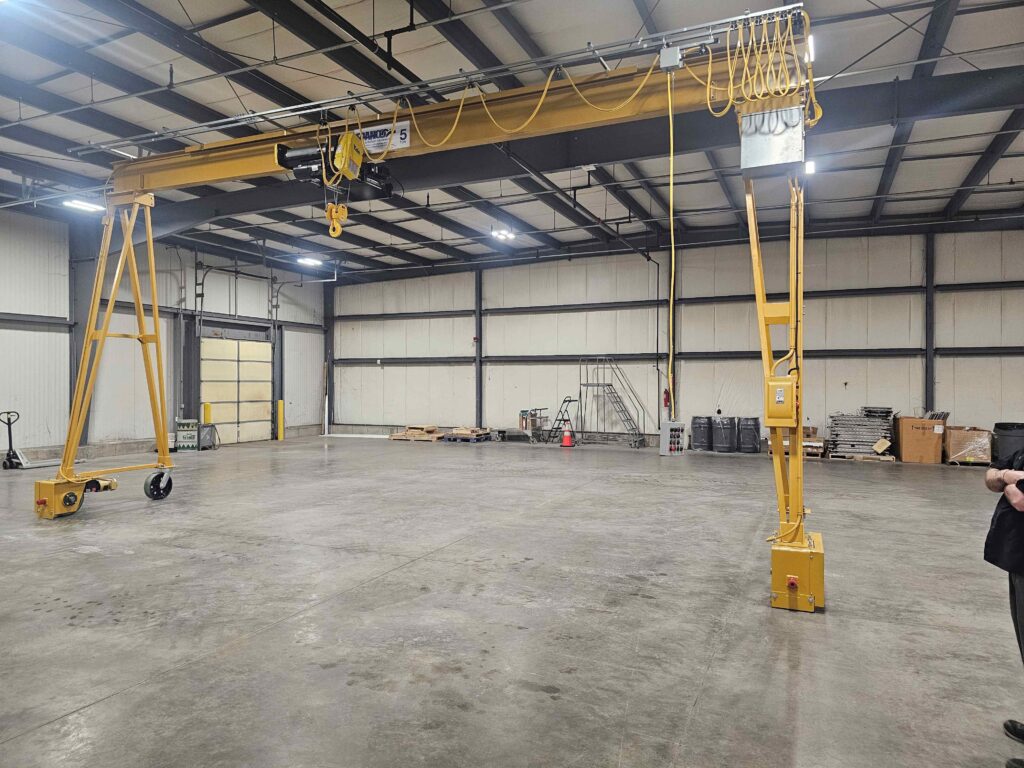
Because gantry cranes support themselves rather than relying on the building structure, they can often be implemented without significant building modifications. Consequently, this approach can reduce project costs while minimizing the engineering required to support runway systems and building connections.
Gantry cranes also provide significant layout flexibility. As production requirements evolve, manufacturers can relocate or reconfigure gantry systems more easily than fixed overhead crane systems.
Additionally, lead times for gantry crane systems are often shorter than those associated with large building-supported runway systems. In an industry experiencing rapid expansion, the ability to deploy new production capacity quickly can be a significant advantage.
Using Tandem Gantry Cranes as a Data Center Fabrication Crane Solution
Many data center modules exceed the dimensions that can be safely handled using a single lifting point. Therefore, manufacturers frequently utilize two gantry cranes operating in tandem to lift and transport long modular skids.
Tandem lifting requires careful coordination between operators and properly designed controls to ensure loads remain balanced throughout the lifting process.
Depending on the application, gantry cranes in the 5-ton to 10-ton capacity range commonly operate in tandem to support the fabrication of long modular assemblies.
To improve maneuverability within the manufacturing environment, manufacturers can incorporate steerable gantry crane designs that simplify positioning and movement throughout the facility.
Integrating Controls for Safe and Efficient Operation
The controls used in tandem lifting applications are just as important as the crane structures themselves.
As an integrator, AFE Crane can incorporate specialized control systems designed to simplify operation and improve safety during skid handling operations.
Examples include:
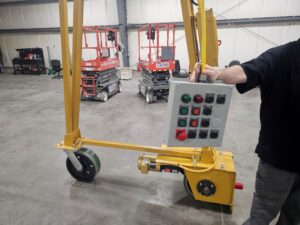
- Cord reel power systems that allow flexible positioning throughout the manufacturing facility.
- A/B/Both control configurations that allow operators to independently control either gantry crane or operate both systems simultaneously.
- Integrated hoist and gantry travel controls that simplify coordinated load movement.
- Custom control solutions designed around the customer’s specific production process.
These integrated solutions help manufacturers improve operator control while supporting safe and efficient movement of large modular assemblies.
Organizations interested in customized lifting solutions can also review our article on Tailoring Your Bridge Crane Solutions.
Planning for Future Growth
The data center industry continues to expand rapidly, and many fabricators expect production volumes to increase over time.
When evaluating a data center fabrication crane, manufacturers should consider not only current production requirements, but also future expansion plans.
Questions to consider include:
- Will skid sizes increase in the future?
- Will additional production bays be added?
- Will production layouts change?
- Is additional lifting capacity anticipated?
Answering these questions early can help ensure the selected material handling solution continues to support production requirements for years to come.
Safety and Compliance Considerations
Whether utilizing gantry cranes or overhead bridge cranes, organizations should ensure equipment is properly designed, inspected, and maintained in accordance with applicable regulations and standards.
The OSHA 1910.179 standard for overhead and gantry cranes provides important guidance regarding crane operation, inspection, and maintenance requirements.
Conclusion
As data center fabrication continues to evolve, manufacturers need material handling systems that provide flexibility, reliability, and scalability. Gantry crane systems offer significant advantages for fabricators producing large modular skids, particularly when facility flexibility, lead time, and future expansion are important considerations.
By combining engineered gantry crane systems with integrated controls and customized material handling solutions, manufacturers can create production environments that safely and efficiently support the growing demands of the data center industry.
Contact AFE Crane
If your organization is fabricating modular data center skids or evaluating material handling solutions for a new production facility, AFE Crane can help. Our team can review your application, evaluate production requirements, and develop a customized lifting solution designed to support your manufacturing process.
Contact AFE Crane to discuss how a custom gantry crane solution can support your data center fabrication operation.
About the Author
 Emily Carrier is the Applications Engineering Manager at AFE Crane and has more than 15 years of experience supporting overhead lifting applications across a wide range of industries. She works closely with customers to evaluate production requirements and develop engineered material handling solutions that improve safety, productivity, and operational flexibility.