
Overview
A manufacturer needed a safer and more efficient method for lifting plastic fuel tanks during agricultural equipment assembly. Three different fuel tank designs moved through the production process. However, each tank had a different center of gravity and required a different lifting configuration.
Previously, operators manually changed the load bar attached to the hoist based on the fuel tank being handled. They also had to manually latch and unlatch the lifting device from each tank.
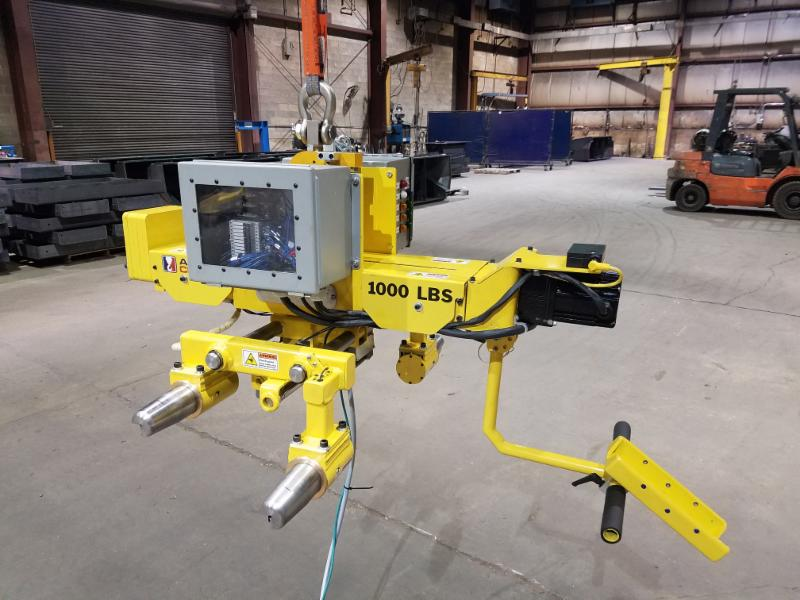
AFE Crane designed and fabricated a custom PLC-controlled below-the-hook lifting device that could accommodate all three fuel tank configurations. The system combined electric linear actuators, sensors, an adjustable hook point, and automated safety controls into a single load bar.
Project Challenges
The three fuel tank designs created a complex lifting application because each had a different center of gravity. As a result, the lifting point needed to change depending on which tank entered the assembly process. Without the correct hook position, the load would not remain level during lifting.
The existing process also required significant operator interaction. Operators manually exchanged load bars and connected or disconnected the lifting device from the tanks. Therefore, AFE Crane needed to develop a system that could accommodate multiple tank configurations while reducing the amount of manual handling required.
Safety integration presented another challenge. The lifting device needed to verify several conditions before allowing crane motions to continue. As a result, the controls had to monitor the load bar and communicate with the hoist, trolley, and bridge controls.
The AFE Crane Solution
AFE Crane engineered a custom load bar controlled by a Programmable Logic Controller (PLC). More than 15 sensors provide inputs to the PLC, allowing the control system to monitor the lifting device throughout operation.
Four spud pins engage the fuel tanks using electric linear actuators. Sensors monitor the engagement process and stop operation if they detect resistance. This provides feedback while the lifting device connects to the tank.
AFE Crane also incorporated an adjustable hook point to accommodate the different centers of gravity. A lead-screw mechanism moves the hook point more than 12 inches. Therefore, the system can position the crane hook above the appropriate center of gravity for each tank configuration and keep the tank level during lifting.
Indicator lights give operators visual feedback about the load bar’s status. They identify when the hook point reaches the appropriate position for loading, unloading, or lifting.
The PLC also integrates the lifting device with the crane controls. If the system detects an unsafe condition, the PLC can interrupt hoist, trolley, and bridge motions.
Project Execution
AFE Crane’s engineering team designed the custom load bar and integrated the mechanical, electrical, and control components into one lifting system. The development process included the electric actuators, sensor network, adjustable hook mechanism, indicator lights, and PLC controls.
AFE Crane developed prototypes to evaluate the device’s operation and safety functions. In addition, the engineering team programmed the PLC to process sensor inputs, operate the motors, control the indicator lights, and interface with the crane.
The team then tested the system and its safety functions. Based on those tests, AFE Crane made adjustments to the lifting device before completing the project.
Finally, AFE Crane provided operator training. The training covered operation of the new load bar and the safety procedures associated with the system.
Conclusion
This project demonstrates how a custom below-the-hook lifting device can address an application that a standard lifting attachment cannot easily accommodate. Instead of using separate load bars for three fuel tank designs, AFE Crane developed one PLC-controlled system capable of adjusting to their different lifting requirements.
The combination of an adjustable hook point, electric actuators, more than 15 sensors, visual indicators, and crane-motion interlocks allowed the lifting device to respond to conditions throughout the lifting sequence. Most importantly, the solution addressed the customer’s original need to reduce manual interaction while handling multiple fuel tank configurations with one lifting system.
Learn More About Custom Load Bars & Custom Below the Hook Lifting Devices
Contact AFE Crane
If your manufacturing process requires a lifting device that standard equipment cannot accommodate, AFE Crane can help. Our engineering team can evaluate the load, lifting process, operator interaction, controls, and equipment requirements to develop a practical solution for your application.
Whether your application requires a custom below-the-hook lifting device, specialized controls, or integration with an existing crane system, AFE Crane provides engineering, fabrication, controls integration, testing, installation, startup, and long-term support.
Contact AFE Crane to discuss your next custom lifting project.