
Overview
Wind turbine blades present a unique material-handling challenge because of their size and lifting requirements. For this application, the customer needed a custom below-the-hook lifting device capable of supporting a 4,000-pound load across a 180-foot span.
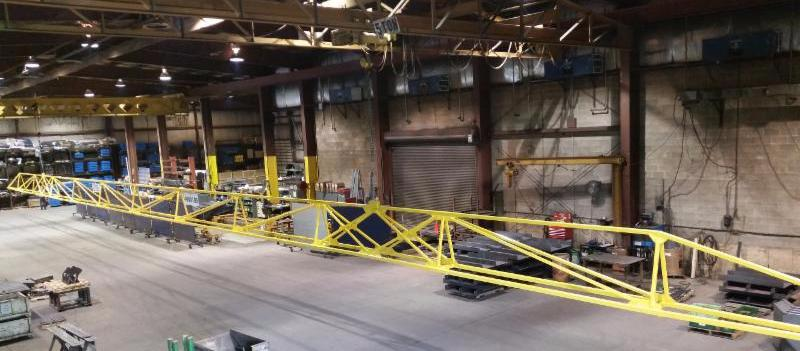
AFE Crane engineered and fabricated a 180-foot truss-style load bar specifically for wind turbine blade handling. The design included 13 load points and two hoist connection points. In addition, AFE Crane designed the load bar in three sections to simplify transportation and field assembly.
Project Challenges
The size of the lifting device presented the primary engineering challenge. At 180 feet long, the load bar needed to support a 4,000-pound capacity while controlling the overall weight of the structure.
The wind turbine blade application also required multiple rigging locations. Therefore, the load bar needed 13 load points along its length and two connection points for the hoisting equipment.
Transportation created another important consideration. Fabricating the load bar as one continuous 180-foot structure would make shipping difficult. As a result, AFE Crane needed a design that could separate into manageable sections for transportation and then connect at the installation site.
The AFE Crane Solution
AFE Crane developed a truss-style below-the-hook load bar for the application. The truss configuration helped control the weight of the lifting device while providing the structure required for the 4,000-pound capacity.
The 180-foot load bar incorporated 13 load points for rigging the wind turbine blade. Two hoist connection points on top of the structure connected the load bar to the lifting equipment.
AFE Crane also incorporated splice assemblies into the design. These connections divided the load bar into three sections for transportation. The sections could then be assembled to create the complete 180-foot lifting device at the jobsite.
Project Execution
AFE Crane engineered and fabricated the load bar at its Cedar Falls, Iowa facility. Before shipment, the team assembled the three sections to create the complete 180-foot structure.
AFE Crane then performed a load test on the assembled lifting device. This process allowed the team to evaluate the completed load bar before disassembling it for transportation to the customer.
The ability to fabricate, assemble, and test the device in-house was particularly important for a below-the-hook device of this size. It provided an opportunity to evaluate the complete assembly rather than individual sections alone.
Conclusion
This project demonstrates how a custom below-the-hook lifting device can address the unusual size and rigging requirements associated with wind turbine blade handling.
The 180-foot load bar combined a truss-style structure, 4,000-pound capacity, 13 load points, two hoist connection points, and three-section construction. Together, these features addressed both the lifting requirements and the practical challenge of transporting a device of this size.
For applications that extend beyond the capabilities of standard lifting equipment, the lifting device itself may require the same level of engineering consideration as the crane or hoist supporting it.
Learn More About Custom Below the Hook Lifting Devices
Contact AFE Crane
If your application involves a large, unusual, or difficult-to-handle load that standard lifting equipment cannot accommodate, AFE Crane can help. Our engineering team can evaluate the load geometry, capacity, rigging requirements, available lifting equipment, and handling process to determine a practical solution.
AFE Crane designs and fabricates custom below-the-hook lifting devices for specialized material-handling applications. Our capabilities include engineering, in-house fabrication, assembly, testing, installation, startup, and long-term support.
Contact AFE Crane to discuss your next custom below-the-hook lifting project.