
Overview
A metal finishing manufacturer needed to replace an aging hoist and trolley used in an automated phosphate dipping process. However, the new equipment had to integrate with the existing runway and PLC controls.
The application also involved severe service and a corrosive operating environment. Therefore, standard hoist and trolley components would not meet all of the project’s requirements.
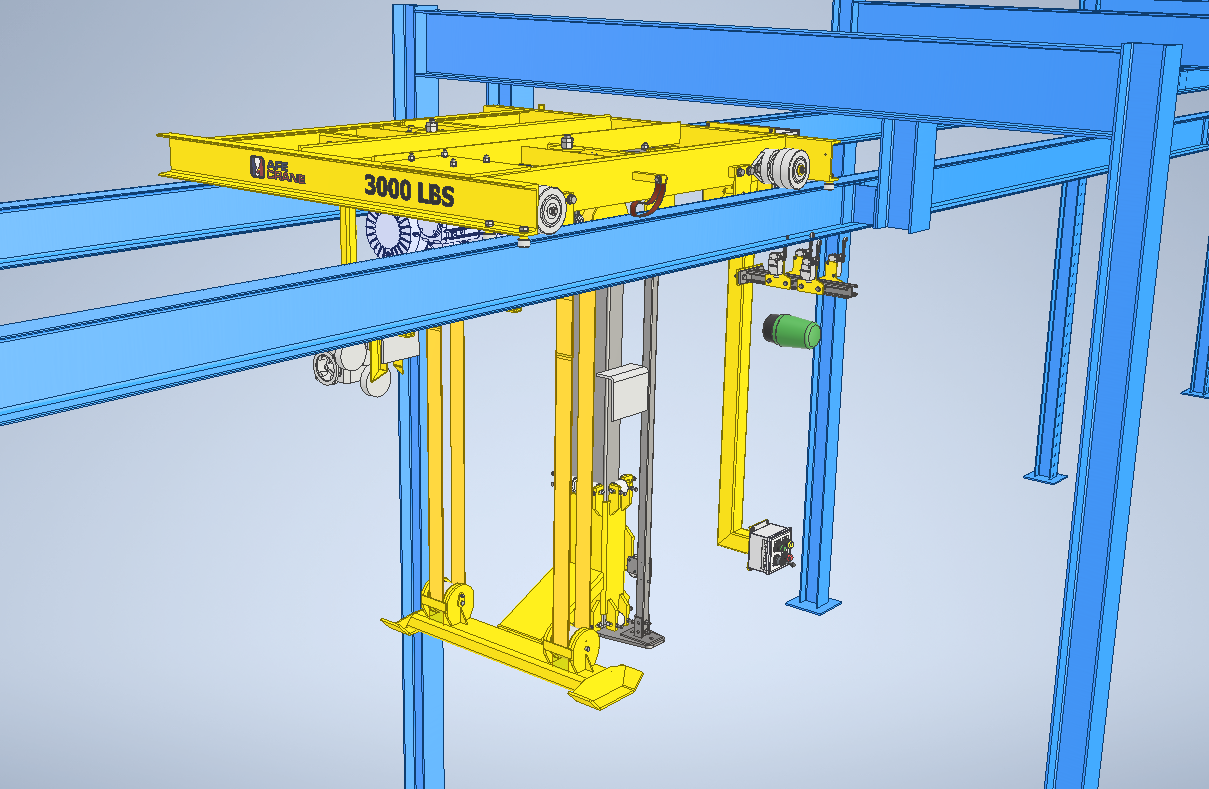
AFE Crane engineered a custom 1.5-ton process crane system for the application. The design incorporated corrosion-resistant components, specialized lifting equipment, and controls that integrated with the customer’s existing automated process.
Project Challenges
Integration with the existing equipment presented the first challenge. AFE Crane needed to reverse engineer the hoist and trolley system to operate on the existing runway. In addition, the new equipment needed to interface with the facility’s PLC controls.
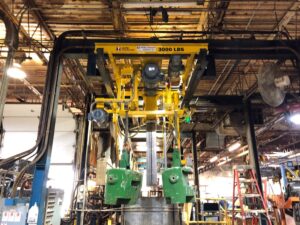
Duty cycle was another important consideration. The application required a 3,000-pound capacity and CMAA Class E severe-service operation. The hoisting equipment also needed to meet an ASME H4 hoist duty classification.
The phosphate dipping environment created additional requirements. Components needed protection from the harsh operating conditions. As a result, the system required corrosion-resistant materials and electrical components.
Finally, the lifting mechanism itself needed modification. The design replaced the previous galvanized steel wire rope with two polyester slings. This change required AFE Crane to redesign the hoist drum around the new lifting media.
The AFE Crane Solution
AFE Crane developed a custom hoist and trolley system around the existing runway, process requirements, and controls.
The upper assembly used a structural steel trolley frame with drive and idler wheels. It also included the hoist and trolley drive shafts. A separate bracket supported the motor and gearbox used for basket rotation.
The lower assembly included a structural steel load bar, sheaves, mast guide, and mast guide rollers. Meanwhile, AFE Crane fabricated the mast from 304 stainless steel. The mast incorporated running surfaces for the lower-unit guide rollers.
AFE Crane also selected corrosion-resistant electrical components. These included stainless steel control and pendant enclosures, NEMA 4 encoders and limit switches, and stainless steel conduit and fittings.
The electrical system carried a NEMA 4/12 rating. It included limit switches, encoders, warning devices, and control enclosures.
AFE Crane powder-coated the upper and lower structural components safety yellow. However, components such as the drive shafts and wheels remained uncoated.
Project Execution
AFE Crane began by taking field measurements of the existing runway and equipment. The engineering team used those measurements to develop the replacement system around the existing infrastructure.
Next, AFE Crane engineered and fabricated the custom assemblies. The team then fully assembled the system at AFE Crane’s facility before shipment.
AFE Crane also performed functional testing on the assembled equipment. This allowed the team to evaluate the system before installation at the customer’s facility.
Finally, AFE Crane worked with the customer’s team during installation, startup, and load testing. The project also included system manuals, spare-parts drawings, and purchased-parts lists in both electronic and hard-copy formats.
Conclusion
This project demonstrates the engineering required when modernizing equipment that forms part of an automated manufacturing process.
AFE Crane could not simply replace the existing hoist with standard equipment. The new system needed to operate on the existing runway, communicate with the facility’s PLC controls, and support severe-service operation. It also needed materials and components suited to the phosphate dipping environment.
AFE Crane addressed those requirements with a custom process crane system built around the existing application. The project combined mechanical design, specialized lifting equipment, corrosion-resistant components, electrical controls, fabrication, testing, and field integration.
For manufacturers with aging process equipment, modernization can require more than replacing individual components. Evaluating the complete mechanical and control system helps determine how new equipment can integrate with the existing production process.
Learn More About Customized Hoist and Trolley System Here
Contact AFE Crane
If your manufacturing process relies on aging or specialized lifting equipment, AFE Crane can help. Our engineering team can evaluate the existing equipment, runway, controls, duty cycle, operating environment, and production requirements.
Whether your application requires a custom process crane, specialized hoist, PLC integration, or modernization of existing lifting equipment, AFE Crane provides engineering, fabrication, controls integration, installation, startup, and long-term support.
Contact AFE Crane to discuss your next process crane or modernization project.